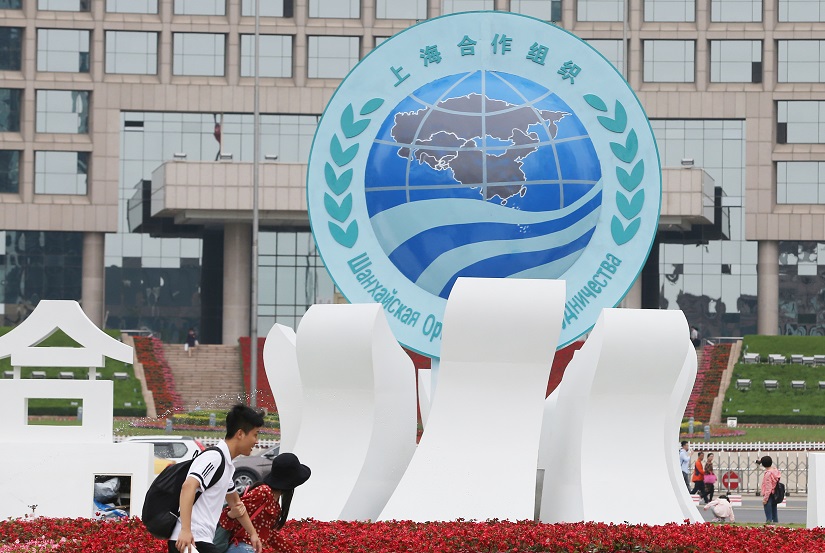
Residents walk past a giant SCO logo in Qingdao, Shandong province, before the SCO Summit opens. Yi Yong / for China Watch
The upcoming 18th summit of the Shanghai Cooperation Organization (SCO) in the eastern Chinese city of Qingdao provides a great opportunity for China to help build a better SCO in the new era. For the best results, it is necessary to set the summit agenda and conduct relevant consultations in advance. Hereafter I’d like to share with you a few thoughts on the details.
First, promote the “Shanghai Spirit”, and raise the awareness of win-win cooperation and building a community with a shared future.
As the core value of the SCO, the “Shanghai Spirit” bears the member states’ aspirations for a new type of international relations and order, and reflects the organization’s new outlook on security, development and civilization. All member states, old or new, should act in line with the spirit. As such, the Qingdao Summit needs to issue a joint declaration on how to carry forward the “Shanghai Spirit” under the new situation, which will feature the elaboration on the spirit’s essence and new measures. The aim is to further strengthen members’ awareness of being emerging and developing countries with an in-depth understanding of common identity, similar status and interest, in a joint effort to build the SCO as a new-type international organization and help foster a new type of world order. It also serves as an important measure to enhance the organization’s cohesion and global influence.
Second, set strategic goals for the SCO in the new era and guide its development in all areas.
Strategic goals that hinge on capability and strategic aspirations determine strategic focuses, strategic layout and measures. The past 17 years have seen a substantial enhancement in the SCO’s capability and global influence with more expectations from member states amid a notably changed international and regional landscape. It is necessary and possible to adjust the existing development goals of the SCO and endow it with bigger strategic missions to keep pace with the times.
I propose to create “four platforms” as the strategic goals for the SCO in the new era. That is, a platform for strategic coordination which promotes strategic trust and international cooperation, helps unite emerging countries and fosters a new type of international order; a platform for security cooperation which works for regional safety and stability; a platform for economic cooperation which will wed China-proposed Belt and Road Initiative with Russia-led Eurasian Economic Union; and a platform for cultural and people-to-people exchanges which promotes good-neighborliness, friendship and cultural exchange.
Among the four platforms, the core should be the platform for strategic coordination. Based on the “Shanghai Spirit”, this platform is designed to strengthen all member states’ awareness of being emerging and developing countries while building a circle of friends and a community with a shared future. In this way, an emerging power different from the West will be formed to boost the global governance in the new era. Such a platform can also strengthen the strategic coordination in major issues internationally and regionally among the member states and make the SCO region more strategically stable, thus making the SCO a direct, external support for safety and development of China’s western region, a geopolitically strategic support for fighting against hegemonic containment, a stage demonstrating China’s responsible image, and a demonstration base for building a human community with a shared future for mankind.
Third, deepen international strategic cooperation to enhance the influence of the SCO on major issues globally and regionally.
The Qingdao Summit shall work to reach a new consensus on what banner the SCO should hold, what road it should advance along and what international order it
should build. I advise the summit adds the promotion of “a new type of international strategic philosophy”, such as a new type of state-to-state relations, and a new type of outlook on safety, development and civilization, into the joint declaration of the summit.
As a major issue of safety in the Asia-Pacific region, the nuclear issue on the Korean Peninsula is concerned directly with the responsibility and security of China and Russia, two major powers in the world and also members of the SCO. There is experience to be drawn on as Kazakhstan, once a nuclear state, renounced nuclear weapons. Therefore it is necessary and favorable for the SCO to help resolve the North Korean nuclear crisis. I suggest that the summit publish a joint declaration on the nuclear issue to expound the common stance of the member states.
Fourth, set up four forums to provide intellectual support for the SCO development.
For this purpose, I propose the participating think tanks at the summit establish four forums. That is, a forum for strategically mutual trust, designed to clear up mistrust and step up the strategic understanding on common strategic concepts and interest, providing advice on strengthening strategic coordination in major international and regional issues among the member states; a forum for common security to combat terrorism, extremism and separatism, to forestall the spread of Islamic extremist activities in West Asia and North Africa to the SCO region, and to prevent the generation of chaos or war by forces outside the region; a forum for pragmatic cooperation that fosters economic cooperation within the SCO framework and contribute to the building of the Belt and Road Initiative; a forum for culturally mutual learning to offset the risks of civilizational conflicts provoked by the West which is cored with a sense of superiority of Western civilization and Western universal values, to forestall the so-called neo-interventionism and color revolution.
The author is a senior consultant of the Center for SCO Studies, and this article is translated from his speech given in the 2018 annual meeting of the center.
All rights reserved. Copying or sharing of any content for other than personal use is prohibited without prior written permission.
Residents walk past a giant SCO logo in Qingdao, Shandong province, before the SCO Summit opens. Yi Yong / for China Watch
The upcoming 18th summit of the Shanghai Cooperation Organization (SCO) in the eastern Chinese city of Qingdao provides a great opportunity for China to help build a better SCO in the new era. For the best results, it is necessary to set the summit agenda and conduct relevant consultations in advance. Hereafter I’d like to share with you a few thoughts on the details.
First, promote the “Shanghai Spirit”, and raise the awareness of win-win cooperation and building a community with a shared future.
As the core value of the SCO, the “Shanghai Spirit” bears the member states’ aspirations for a new type of international relations and order, and reflects the organization’s new outlook on security, development and civilization. All member states, old or new, should act in line with the spirit. As such, the Qingdao Summit needs to issue a joint declaration on how to carry forward the “Shanghai Spirit” under the new situation, which will feature the elaboration on the spirit’s essence and new measures. The aim is to further strengthen members’ awareness of being emerging and developing countries with an in-depth understanding of common identity, similar status and interest, in a joint effort to build the SCO as a new-type international organization and help foster a new type of world order. It also serves as an important measure to enhance the organization’s cohesion and global influence.
Second, set strategic goals for the SCO in the new era and guide its development in all areas.
Strategic goals that hinge on capability and strategic aspirations determine strategic focuses, strategic layout and measures. The past 17 years have seen a substantial enhancement in the SCO’s capability and global influence with more expectations from member states amid a notably changed international and regional landscape. It is necessary and possible to adjust the existing development goals of the SCO and endow it with bigger strategic missions to keep pace with the times.
I propose to create “four platforms” as the strategic goals for the SCO in the new era. That is, a platform for strategic coordination which promotes strategic trust and international cooperation, helps unite emerging countries and fosters a new type of international order; a platform for security cooperation which works for regional safety and stability; a platform for economic cooperation which will wed China-proposed Belt and Road Initiative with Russia-led Eurasian Economic Union; and a platform for cultural and people-to-people exchanges which promotes good-neighborliness, friendship and cultural exchange.
Among the four platforms, the core should be the platform for strategic coordination. Based on the “Shanghai Spirit”, this platform is designed to strengthen all member states’ awareness of being emerging and developing countries while building a circle of friends and a community with a shared future. In this way, an emerging power different from the West will be formed to boost the global governance in the new era. Such a platform can also strengthen the strategic coordination in major issues internationally and regionally among the member states and make the SCO region more strategically stable, thus making the SCO a direct, external support for safety and development of China’s western region, a geopolitically strategic support for fighting against hegemonic containment, a stage demonstrating China’s responsible image, and a demonstration base for building a human community with a shared future for mankind.
Third, deepen international strategic cooperation to enhance the influence of the SCO on major issues globally and regionally.
The Qingdao Summit shall work to reach a new consensus on what banner the SCO should hold, what road it should advance along and what international order it
should build. I advise the summit adds the promotion of “a new type of international strategic philosophy”, such as a new type of state-to-state relations, and a new type of outlook on safety, development and civilization, into the joint declaration of the summit.
As a major issue of safety in the Asia-Pacific region, the nuclear issue on the Korean Peninsula is concerned directly with the responsibility and security of China and Russia, two major powers in the world and also members of the SCO. There is experience to be drawn on as Kazakhstan, once a nuclear state, renounced nuclear weapons. Therefore it is necessary and favorable for the SCO to help resolve the North Korean nuclear crisis. I suggest that the summit publish a joint declaration on the nuclear issue to expound the common stance of the member states.
Fourth, set up four forums to provide intellectual support for the SCO development.
For this purpose, I propose the participating think tanks at the summit establish four forums. That is, a forum for strategically mutual trust, designed to clear up mistrust and step up the strategic understanding on common strategic concepts and interest, providing advice on strengthening strategic coordination in major international and regional issues among the member states; a forum for common security to combat terrorism, extremism and separatism, to forestall the spread of Islamic extremist activities in West Asia and North Africa to the SCO region, and to prevent the generation of chaos or war by forces outside the region; a forum for pragmatic cooperation that fosters economic cooperation within the SCO framework and contribute to the building of the Belt and Road Initiative; a forum for culturally mutual learning to offset the risks of civilizational conflicts provoked by the West which is cored with a sense of superiority of Western civilization and Western universal values, to forestall the so-called neo-interventionism and color revolution.
The author is a senior consultant of the Center for SCO Studies, and this article is translated from his speech given in the 2018 annual meeting of the center.
All rights reserved. Copying or sharing of any content for other than personal use is prohibited without prior written permission.