China-EU cooperate to embrace a more diverse and connected world
By Sophie Bu |
China Watch |
Updated: 2018-07-12 15:22
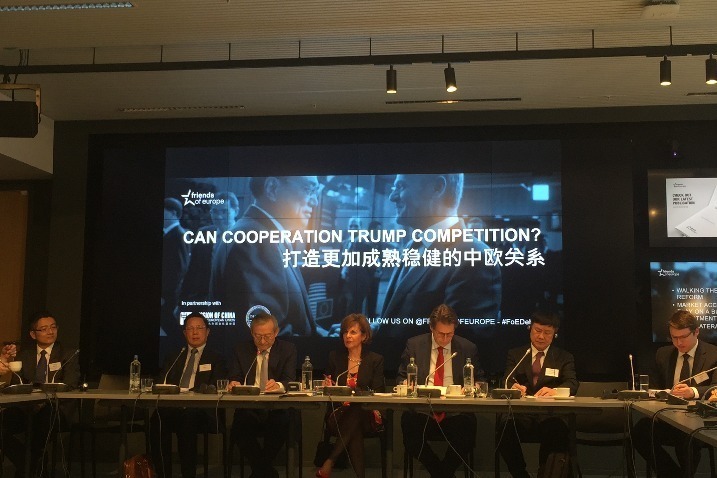
These days, against a backdrop of geopolitical changes, global relationships have become terribly complicated and divided. The conflict between unilateralism and the open economy is intensified by many unilateral actions, such as the US Section 301 investigation. China has been a strong supporter of the open economy for a long time. In 2013, China proposed the Belt and Road Initiative (BRI), focusing on connectivity and cooperation between Eurasian countries. The initiative calls for the integration of the region into a cohesive economic area through building infrastructure and broadening trade. APEC developed a Connectivity Blueprint for 2015-2025. Representing 60 percent of global GDP, population, and trade, the 12th Asia-Europe Meeting (ASEM) summit will take place in October 2018, in Brussels, Belgium, with the theme “Europe and Asia: global partners for global challenges.” Connectivity is one of the most important topics. The importance of connectivity has been widely accepted across Eurasia.
EU-China cooperation on connectivity doesn’t stop on paper. Both have invested multiple resources and energy into establishing a more cohesive EU-China relationship. For example, located 25 kilometers from Minsk, the China-Belarus industrial park is the largest among BRI countries. Well-connected by an international airport, railway lines, and transformational highways, the 91.5-square-kilometer area offers ample business opportunities for the Customs Union of Belarus, Russia, and Kazakhstan, as well as neighboring European countries.
As construction of industrial parks proceeds, it becomes clear that cross-border business requires facilitation more than infrastructure. Forums such as the EU-China summit and ASEM summit are effective and critical, but far from enough. The exchange of ideas should be constant and requires a dedicated channel. And in day-to-day business, there are many questions to be answered, due diligence to be conducted, and negotiations to be done. Language barriers and exploding information on separate websites do not help the situation. Researchers find it hard to analyze the impact of issues in traditional ways. Decisions need to be based on facts, not just personal experiences. But there are too many facts. Moreover, in the rapidly changing world of today, we see alternative facts and fake news all the time. Researchers need to publish under increasing time pressures, while policy-makers and business leaders need to respond ever faster to policy and market changes. All these challenge us to find new ways to handle issues.
If this is the reality we must face, can we improve connectivity by taking advantage of the latest technology?
I think we can. For example, recent research in natural language processing is developing quickly. Automatically extracting information from the whole internet, even from notes of reports, is possible. Smart Q&A systems show improved results each day. New research models published last month will be adopted immediately. Many long lasting problems, including language barriers and information integration, can be largely improved by applying the right technology. Researchers could find the latest EU-China economic data in one place and in real time. Policy-makers can respond quickly to new bilateral events. Investors will benefit from identifiable business opportunities.
To evaluate the impact of an idea, the best way is to implement it, but in small scope and with careful design. The China-Belarus industrial park is strategically located at the midpoint of the Eurasian continent. Building such a digital platform will help sustain the success of the industrial park and amplify its impact to the entire Commonwealth of Independent States, creating another midpoint of EU-China thought exchanges. By combining the efforts of policy-makers, researchers, investors, and technology providers, we can expect to see new developments in the EU-China relationship. At least, this is an idea worth thinking about.
Sophie Bu is partner at Shannon.AI. The author contributed this article to China Watch exclusively. The views expressed do not necessarily reflect those of China Watch.
All rights reserved. Copying or sharing of any content for other than personal use is prohibited without prior written permission.
These days, against a backdrop of geopolitical changes, global relationships have become terribly complicated and divided. The conflict between unilateralism and the open economy is intensified by many unilateral actions, such as the US Section 301 investigation. China has been a strong supporter of the open economy for a long time. In 2013, China proposed the Belt and Road Initiative (BRI), focusing on connectivity and cooperation between Eurasian countries. The initiative calls for the integration of the region into a cohesive economic area through building infrastructure and broadening trade. APEC developed a Connectivity Blueprint for 2015-2025. Representing 60 percent of global GDP, population, and trade, the 12th Asia-Europe Meeting (ASEM) summit will take place in October 2018, in Brussels, Belgium, with the theme “Europe and Asia: global partners for global challenges.” Connectivity is one of the most important topics. The importance of connectivity has been widely accepted across Eurasia.
EU-China cooperation on connectivity doesn’t stop on paper. Both have invested multiple resources and energy into establishing a more cohesive EU-China relationship. For example, located 25 kilometers from Minsk, the China-Belarus industrial park is the largest among BRI countries. Well-connected by an international airport, railway lines, and transformational highways, the 91.5-square-kilometer area offers ample business opportunities for the Customs Union of Belarus, Russia, and Kazakhstan, as well as neighboring European countries.
As construction of industrial parks proceeds, it becomes clear that cross-border business requires facilitation more than infrastructure. Forums such as the EU-China summit and ASEM summit are effective and critical, but far from enough. The exchange of ideas should be constant and requires a dedicated channel. And in day-to-day business, there are many questions to be answered, due diligence to be conducted, and negotiations to be done. Language barriers and exploding information on separate websites do not help the situation. Researchers find it hard to analyze the impact of issues in traditional ways. Decisions need to be based on facts, not just personal experiences. But there are too many facts. Moreover, in the rapidly changing world of today, we see alternative facts and fake news all the time. Researchers need to publish under increasing time pressures, while policy-makers and business leaders need to respond ever faster to policy and market changes. All these challenge us to find new ways to handle issues.
If this is the reality we must face, can we improve connectivity by taking advantage of the latest technology?
I think we can. For example, recent research in natural language processing is developing quickly. Automatically extracting information from the whole internet, even from notes of reports, is possible. Smart Q&A systems show improved results each day. New research models published last month will be adopted immediately. Many long lasting problems, including language barriers and information integration, can be largely improved by applying the right technology. Researchers could find the latest EU-China economic data in one place and in real time. Policy-makers can respond quickly to new bilateral events. Investors will benefit from identifiable business opportunities.
To evaluate the impact of an idea, the best way is to implement it, but in small scope and with careful design. The China-Belarus industrial park is strategically located at the midpoint of the Eurasian continent. Building such a digital platform will help sustain the success of the industrial park and amplify its impact to the entire Commonwealth of Independent States, creating another midpoint of EU-China thought exchanges. By combining the efforts of policy-makers, researchers, investors, and technology providers, we can expect to see new developments in the EU-China relationship. At least, this is an idea worth thinking about.
Sophie Bu is partner at Shannon.AI. The author contributed this article to China Watch exclusively. The views expressed do not necessarily reflect those of China Watch.
All rights reserved. Copying or sharing of any content for other than personal use is prohibited without prior written permission.