Global climate change governance and sustainable development must be addressed
By Yao Wang, Mathias Lund Larsen |
China Watch |
Updated: 2018-07-17 13:49
The last couple of years have presented us with several monumental shifts, in particular, recent changes in the US’ approach to foreign policy. Amid increasing unpredictability and fragmentation, China and EU are working together as pillars of stability. This is particularly true of climate change governance and green finance. With climate change having become a central component of modern-day international affairs, the US retraction from the field leaves a vacuum in global governance. As the only major power to withdraw, the unity of the rest of the group means that the global commitment to climate change remains unshaken, but US influence within it is reduced. This was indicated most clearly at the G20 summit in Hamburg in July 2017, where US President Donald Trump was isolated with a 19-1 split on climate change, and led German Chancellor Angela Merkel to “deplore” the US decision to withdraw.
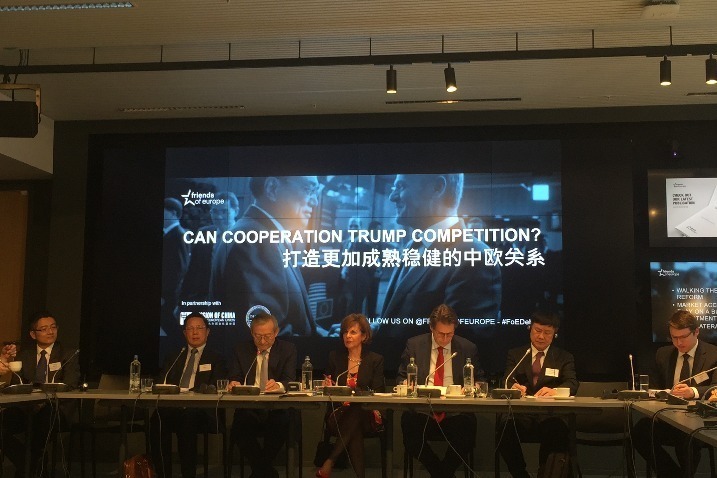
China’s new role in climate change was addressed in President Xi Jinping’s speech in Davos at the World Economic Forum’s 2017 session. Within the implicit context of the demise of US leadership of globalization and substantial anti-globalization sentiment across developed countries, Xi advocated joint efforts against climate change and highlighted the mutual benefits of the globalization of trade, finance and governance. With such commitment, global climate change efforts are currently spearheaded jointly by China and the EU. This was solidified in the statement which came out of the EU-China summit of 2017 as voiced by the president of the European Commission: “As far as the European side is concerned, we were happy to see that China is agreeing to our unhappiness about the American climate decision. This is helpful, this is responsible, and this is about inviting both, China and the European Union, to proceed with the implementation of the Paris Agreement". It is critical that this year’s China-EU summit further formalizes and solidifies their joint commitment to climate finance.
G20 Green Finance Study Group
Internationally, China and the EU are actively advocating the development of green finance. Under China’s presidency of the G20, green finance became a key theme at the G20 agenda for the first time. The G20 Green Finance Study Group was launched as part of this effort to support the G20’s goal of strong, sustainable and balanced growth. This initiative taken by China was continued by Germany and the EU in the 2017 G20 summit in Hamburg and will advance further toward the next G20 meeting in Argentina. As exemplified by numerous cooperation areas and avenues, China sees the EU as a strategic partner in promoting green finance internationally and continues joint efforts toward environmental sustainability in the future. This year’s summit has to stress the implementation of the conclusions of the G20 Green Finance Study Group in all countries globally, not just inside the G20. China and the EU are instrumental in this process given their role in global financial governance and should use the occasion of the summit to harmonize and coordinate their efforts.
Green finance standards harmonization
Furthermore, the China and EU are working closely together on harmonizing global green finance practices. The lack of clear definitions in some markets and the lack of comparability of different definitions in different markets impeded future growth of the green finance market and green capital flows, so efforts need to be made to enhance the comparability and consistency between different standards. Consider a concrete example of such efforts, on the margins of the COP 23 climate talks in Bonn, the Green Finance Committee (GFC) of the China Society for Finance and Banking and the European Investment Bank (EIB) launched a white paper that provides an international comparison of several green bond standards. This paper paves the way for enhancing the consistency of green finance definitions and standards between China and the EU. This white paper reflects the strategic partnership between China and the EU to promote international cooperation in this field. As the EU is launching a green finance taxonomy and China is launching a green industry catalogue, these dynamic efforts will continue.
Central banks and supervisors network
Central banks are critical in the effort to green the global financial system. To strengthen the global response required to meet the goals of the Paris Agreement by ensuring the financial system’s management of risk and mobilization of green finance, eight central banks and supervisors established the Central Banks and Supervisors Network for Greening the Financial System, or NGFS. This number has expanded to cover 15 countries by mid 2018 and is expected to continue to grow. As China is a key driver of the initiative and nine EU member countries are participating, including the European Central Bank, this year’s China-EU summit should work on coordinating these efforts as the initiative matures. While individual central banks have to carry out the work in practice, the summit is an opportunity to both scale up and better harmonize global efforts.
Greening the Belt and Road Initiative
Lastly, this year’s China-EU summit provides a great opportunity to enhance cooperation on the Belt and Road Initiative. At each end of the silk road, China and the EU’s joint engagement is critical for the initiative’s success. Estimates are that the total BRI investment requirement is $ 4-8 trillion. Simply put, if sustainability is not integrated into the BRI, the SDGs and the Paris Agreement will be impossible to achieve; this is simply due to the investment scale, and since the BRI covers half the world’s population, 75 percent of energy resources and 40 percent of global GDP. As both the EU and China are strongly committed to sustainable development and combating climate change, this year’s summit must address how to further integrate these policy goals into meeting the financing needs of the BRI.
Yao Wang is director general of International Institute of Green Finance (IIGF). Mathias Lund Larsen is head of the International Cooperation Department, IIGF. The authors contributed this article to China Watch exclusively. The views expressed do not necessarily reflect those of China Watch.
All rights reserved. Copying or sharing of any content for other than personal use is prohibited without prior written permission.
The last couple of years have presented us with several monumental shifts, in particular, recent changes in the US’ approach to foreign policy. Amid increasing unpredictability and fragmentation, China and EU are working together as pillars of stability. This is particularly true of climate change governance and green finance. With climate change having become a central component of modern-day international affairs, the US retraction from the field leaves a vacuum in global governance. As the only major power to withdraw, the unity of the rest of the group means that the global commitment to climate change remains unshaken, but US influence within it is reduced. This was indicated most clearly at the G20 summit in Hamburg in July 2017, where US President Donald Trump was isolated with a 19-1 split on climate change, and led German Chancellor Angela Merkel to “deplore” the US decision to withdraw.
China’s new role in climate change was addressed in President Xi Jinping’s speech in Davos at the World Economic Forum’s 2017 session. Within the implicit context of the demise of US leadership of globalization and substantial anti-globalization sentiment across developed countries, Xi advocated joint efforts against climate change and highlighted the mutual benefits of the globalization of trade, finance and governance. With such commitment, global climate change efforts are currently spearheaded jointly by China and the EU. This was solidified in the statement which came out of the EU-China summit of 2017 as voiced by the president of the European Commission: “As far as the European side is concerned, we were happy to see that China is agreeing to our unhappiness about the American climate decision. This is helpful, this is responsible, and this is about inviting both, China and the European Union, to proceed with the implementation of the Paris Agreement". It is critical that this year’s China-EU summit further formalizes and solidifies their joint commitment to climate finance.
G20 Green Finance Study Group
Internationally, China and the EU are actively advocating the development of green finance. Under China’s presidency of the G20, green finance became a key theme at the G20 agenda for the first time. The G20 Green Finance Study Group was launched as part of this effort to support the G20’s goal of strong, sustainable and balanced growth. This initiative taken by China was continued by Germany and the EU in the 2017 G20 summit in Hamburg and will advance further toward the next G20 meeting in Argentina. As exemplified by numerous cooperation areas and avenues, China sees the EU as a strategic partner in promoting green finance internationally and continues joint efforts toward environmental sustainability in the future. This year’s summit has to stress the implementation of the conclusions of the G20 Green Finance Study Group in all countries globally, not just inside the G20. China and the EU are instrumental in this process given their role in global financial governance and should use the occasion of the summit to harmonize and coordinate their efforts.
Green finance standards harmonization
Furthermore, the China and EU are working closely together on harmonizing global green finance practices. The lack of clear definitions in some markets and the lack of comparability of different definitions in different markets impeded future growth of the green finance market and green capital flows, so efforts need to be made to enhance the comparability and consistency between different standards. Consider a concrete example of such efforts, on the margins of the COP 23 climate talks in Bonn, the Green Finance Committee (GFC) of the China Society for Finance and Banking and the European Investment Bank (EIB) launched a white paper that provides an international comparison of several green bond standards. This paper paves the way for enhancing the consistency of green finance definitions and standards between China and the EU. This white paper reflects the strategic partnership between China and the EU to promote international cooperation in this field. As the EU is launching a green finance taxonomy and China is launching a green industry catalogue, these dynamic efforts will continue.
Central banks and supervisors network
Central banks are critical in the effort to green the global financial system. To strengthen the global response required to meet the goals of the Paris Agreement by ensuring the financial system’s management of risk and mobilization of green finance, eight central banks and supervisors established the Central Banks and Supervisors Network for Greening the Financial System, or NGFS. This number has expanded to cover 15 countries by mid 2018 and is expected to continue to grow. As China is a key driver of the initiative and nine EU member countries are participating, including the European Central Bank, this year’s China-EU summit should work on coordinating these efforts as the initiative matures. While individual central banks have to carry out the work in practice, the summit is an opportunity to both scale up and better harmonize global efforts.
Greening the Belt and Road Initiative
Lastly, this year’s China-EU summit provides a great opportunity to enhance cooperation on the Belt and Road Initiative. At each end of the silk road, China and the EU’s joint engagement is critical for the initiative’s success. Estimates are that the total BRI investment requirement is $ 4-8 trillion. Simply put, if sustainability is not integrated into the BRI, the SDGs and the Paris Agreement will be impossible to achieve; this is simply due to the investment scale, and since the BRI covers half the world’s population, 75 percent of energy resources and 40 percent of global GDP. As both the EU and China are strongly committed to sustainable development and combating climate change, this year’s summit must address how to further integrate these policy goals into meeting the financing needs of the BRI.
Yao Wang is director general of International Institute of Green Finance (IIGF). Mathias Lund Larsen is head of the International Cooperation Department, IIGF. The authors contributed this article to China Watch exclusively. The views expressed do not necessarily reflect those of China Watch.
All rights reserved. Copying or sharing of any content for other than personal use is prohibited without prior written permission.