By Yann Bonduelle |
chinawatch.cn |
Updated: 2019-06-18 17:05
The world is not short of challenges where technology can and should play a significant role. Reaching the UN’s 17 Sustainable Development Goals will require major technology achievements, particularly in energy, connectivity, mobility and healthcare.
The pressure is on to ensure that technology innovations drive development effectively and consistently. How should governments at a macro level and businesses at a micro level work together to develop the right conditions to accelerate the positive impact of technology innovation?
Macro tools include carrots and sticks such as tax incentives, trade policies, safeguarding of intellectual property rights, and legal support. Scholars such as Jakob Edler and Jan Fagerberg provide a list of 15 categories of tools in “Innovation policy: what, why, and how” in the Oxford Review of Economic Policy.
On the micro side, businesses can amplify or minimize the effects of macro measures created to promote innovation. Apple’s products are good examples of innovations benefiting from supportive macro measures: Apple used 13 technologies resulting from public investments including DRAM cache and Click Wheel. Apple has mastered how to leverage macro-driven technology advances, and how to combine them with its own innovation ingredients.
However, there are limits to using macro measures to drive innovation. Solar energy’s penetration is still marginal despite technology subsidies. Many innovation hubs fail to achieve their ambitions despite government help. The reasons for these failures include timing, poorly designed incentives, and unclear value propositions. Despite good intentions, macro measures will only work if businesses are working in the right direction as well.
To accelerate innovation-driven development, businesses have a critical role to play. They can be the most effective relay of government’s macro measures supporting innovation. This is easy for the Apple’s of the world. It is less obvious for traditional businesses who need to transform through adoption of technology. The challenge for these traditional businesses is to adopt the right technology such as robotics, connectivity and artificial intelligence.
Creating commercially successful innovations usually follows a three-stage innovation process. First, a small-scale experiment establishes a Proof of Concept, or PoC, establishing that the innovative idea can be built and will deliver what is expected. A PoC is usually quick and requires few resources. Then a larger scale pilot application is built and if that is successful, a fully scaled-up version of the innovation is constructed. Each step requires increased investment.
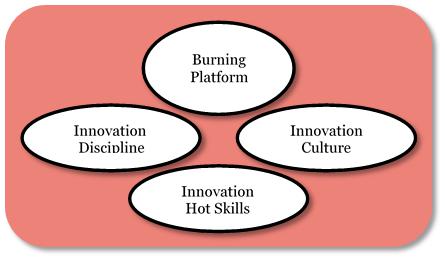
At company level, effectiveness in scaling up innovation is driven by four elements.
The first element, is a burning platform. Is there an existential threat to the organization which requires increasing investments in innovation? Without a burning platform, making sustainable, consistent changes is difficult.
Countries experience macro issues that impact sectors of the economy very differently. For example, aging populations and a gradual fertility decline combined with low unemployment create major stresses in an organizations’ ability to recruit the people it needs.
The Japan Ministry of Economy, Trade and Industry has been active in promoting measures to adapt to the new reality of an aging population, for example, the importance of constant learning.
Increased domestic and international competition, including unexpected competitors, is often an effective burning platform for businesses. In retail banking, the entry of competitive payment options and digital banks is threatening incumbents.
For the Japanese government, the burning platform is the increasing cost of healthcare and pensions. This motivated the launch of a new visa system for foreign workers: 345,150 blue-collar workers in construction, farming and nursing care are expected to come to Japan over the next five years.
The second element is innovation culture. Are working practices in individual countries in line with what is required to develop successful innovation? Commercially successful innovation requires a culture of experimentation; a willingness to fail fast; a systematic application of agile development methodology, and establishing trusted partnerships to create better products, services and processes. Networking and sharing information with organizations is also crucial.
There are wide differences across G20 countries in these areas. In some cultures, being trustworthy is seen as part of a person’s fundamental personality. A person is judged to be trustworthy based on personal character, and is expected to always be trustworthy – no matter the context.
However, in other cultures, individual behavior, including trustworthiness, depends on context. While a person can be judged to be trustworthy by a partner in a joint venture context, that does not mean that they will always behave the same way with that partner, regardless of context. This makes partnerships between individuals or companies of different cultures interesting and sometimes unpredictable.
The third element is innovation discipline. Many business organizations realize they need to become data-driven, incorporating new technologies. That requires developing innovation in-house with partners, contracting innovation, or buying innovation. Whatever the solution, commercial success will take a few years and investments will be required throughout.
Innovation investments are unlikely to become very quickly clear successes or failures and that means developing a portfolio of innovation projects and monitoring those regularly. When the road is bumpy and investments do not show expected progress, it is tempting to redirect investment into other areas requiring a short-term boost.
On the other hand, when results are clearly negative, it is tempting to try just one more test. Making the right decisions is influenced by an organization’s corporate culture, the importance of hierarchies, the presence of or trust in real technical experts, and duration in each job.
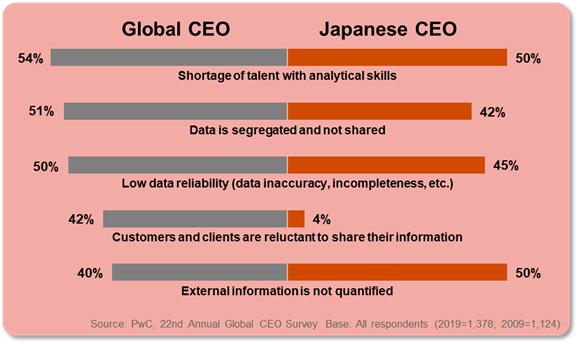
The fourth element is innovation hot skills. Most businesses are launching or growing their own innovation programs. As a result, there is a shortage of emerging tech skills. In the 2019 PwC CEO survey, CEOs felt that “shortage of talent with analytical skills” was the No 1 factor preventing them from making more data-driven decisions.
Beyond analytical and emerging tech skills, people who can leverage external innovation into a company’s products, services and processes are also in short supply. Organizations therefore need to take responsibility to train their employees in these new skills. That in itself is a long-term investment.
The CEOs in our survey were worried about their ability to innovate effectively without the requisite skills, even while 85 percent thought AI would significantly affect the way they do business in the next five years.
Generally speaking, innovation ingredients are nurtured or starved by the environment in each country and organization. Innovation-driven development is at its most effective when organizations amplify the national measures that promote innovation. That happens when organizations score well in the four categories of innovation ingredients outlined here.
The ingredients will be more or less present in different types of organizations. Startups are long on innovation culture and hot skills, while not always great on innovation discipline. Established organizations are short on innovation hot skills and innovation culture, and should be long on innovation discipline.
In other words, businesses must conduct a review of their innovation environment to paint a realistic picture of innovation potential. That in turn should guide expectations and help identify partners with complementary strengths.
Yann Bonduelle is partner and data &analytics leader of PwC Japan Group.
The author contributed this article to China Watch exclusively. The views expressed do not necessarily reflect those of China Watch.
All rights reserved. Copying or sharing of any content for other than personal use is prohibited without prior written permission.
The world is not short of challenges where technology can and should play a significant role. Reaching the UN’s 17 Sustainable Development Goals will require major technology achievements, particularly in energy, connectivity, mobility and healthcare.
The pressure is on to ensure that technology innovations drive development effectively and consistently. How should governments at a macro level and businesses at a micro level work together to develop the right conditions to accelerate the positive impact of technology innovation?
Macro tools include carrots and sticks such as tax incentives, trade policies, safeguarding of intellectual property rights, and legal support. Scholars such as Jakob Edler and Jan Fagerberg provide a list of 15 categories of tools in “Innovation policy: what, why, and how” in the Oxford Review of Economic Policy.
On the micro side, businesses can amplify or minimize the effects of macro measures created to promote innovation. Apple’s products are good examples of innovations benefiting from supportive macro measures: Apple used 13 technologies resulting from public investments including DRAM cache and Click Wheel. Apple has mastered how to leverage macro-driven technology advances, and how to combine them with its own innovation ingredients.
However, there are limits to using macro measures to drive innovation. Solar energy’s penetration is still marginal despite technology subsidies. Many innovation hubs fail to achieve their ambitions despite government help. The reasons for these failures include timing, poorly designed incentives, and unclear value propositions. Despite good intentions, macro measures will only work if businesses are working in the right direction as well.
To accelerate innovation-driven development, businesses have a critical role to play. They can be the most effective relay of government’s macro measures supporting innovation. This is easy for the Apple’s of the world. It is less obvious for traditional businesses who need to transform through adoption of technology. The challenge for these traditional businesses is to adopt the right technology such as robotics, connectivity and artificial intelligence.
Creating commercially successful innovations usually follows a three-stage innovation process. First, a small-scale experiment establishes a Proof of Concept, or PoC, establishing that the innovative idea can be built and will deliver what is expected. A PoC is usually quick and requires few resources. Then a larger scale pilot application is built and if that is successful, a fully scaled-up version of the innovation is constructed. Each step requires increased investment.
At company level, effectiveness in scaling up innovation is driven by four elements.
The first element, is a burning platform. Is there an existential threat to the organization which requires increasing investments in innovation? Without a burning platform, making sustainable, consistent changes is difficult.
Countries experience macro issues that impact sectors of the economy very differently. For example, aging populations and a gradual fertility decline combined with low unemployment create major stresses in an organizations’ ability to recruit the people it needs.
The Japan Ministry of Economy, Trade and Industry has been active in promoting measures to adapt to the new reality of an aging population, for example, the importance of constant learning.
Increased domestic and international competition, including unexpected competitors, is often an effective burning platform for businesses. In retail banking, the entry of competitive payment options and digital banks is threatening incumbents.
For the Japanese government, the burning platform is the increasing cost of healthcare and pensions. This motivated the launch of a new visa system for foreign workers: 345,150 blue-collar workers in construction, farming and nursing care are expected to come to Japan over the next five years.
The second element is innovation culture. Are working practices in individual countries in line with what is required to develop successful innovation? Commercially successful innovation requires a culture of experimentation; a willingness to fail fast; a systematic application of agile development methodology, and establishing trusted partnerships to create better products, services and processes. Networking and sharing information with organizations is also crucial.
There are wide differences across G20 countries in these areas. In some cultures, being trustworthy is seen as part of a person’s fundamental personality. A person is judged to be trustworthy based on personal character, and is expected to always be trustworthy – no matter the context.
However, in other cultures, individual behavior, including trustworthiness, depends on context. While a person can be judged to be trustworthy by a partner in a joint venture context, that does not mean that they will always behave the same way with that partner, regardless of context. This makes partnerships between individuals or companies of different cultures interesting and sometimes unpredictable.
The third element is innovation discipline. Many business organizations realize they need to become data-driven, incorporating new technologies. That requires developing innovation in-house with partners, contracting innovation, or buying innovation. Whatever the solution, commercial success will take a few years and investments will be required throughout.
Innovation investments are unlikely to become very quickly clear successes or failures and that means developing a portfolio of innovation projects and monitoring those regularly. When the road is bumpy and investments do not show expected progress, it is tempting to redirect investment into other areas requiring a short-term boost.
On the other hand, when results are clearly negative, it is tempting to try just one more test. Making the right decisions is influenced by an organization’s corporate culture, the importance of hierarchies, the presence of or trust in real technical experts, and duration in each job.
The fourth element is innovation hot skills. Most businesses are launching or growing their own innovation programs. As a result, there is a shortage of emerging tech skills. In the 2019 PwC CEO survey, CEOs felt that “shortage of talent with analytical skills” was the No 1 factor preventing them from making more data-driven decisions.
Beyond analytical and emerging tech skills, people who can leverage external innovation into a company’s products, services and processes are also in short supply. Organizations therefore need to take responsibility to train their employees in these new skills. That in itself is a long-term investment.
The CEOs in our survey were worried about their ability to innovate effectively without the requisite skills, even while 85 percent thought AI would significantly affect the way they do business in the next five years.
Generally speaking, innovation ingredients are nurtured or starved by the environment in each country and organization. Innovation-driven development is at its most effective when organizations amplify the national measures that promote innovation. That happens when organizations score well in the four categories of innovation ingredients outlined here.
The ingredients will be more or less present in different types of organizations. Startups are long on innovation culture and hot skills, while not always great on innovation discipline. Established organizations are short on innovation hot skills and innovation culture, and should be long on innovation discipline.
In other words, businesses must conduct a review of their innovation environment to paint a realistic picture of innovation potential. That in turn should guide expectations and help identify partners with complementary strengths.
Yann Bonduelle is partner and data &analytics leader of PwC Japan Group.
The author contributed this article to China Watch exclusively. The views expressed do not necessarily reflect those of China Watch.
All rights reserved. Copying or sharing of any content for other than personal use is prohibited without prior written permission.